
Running a small business in 2026 means competing against companies that have enterprise-grade technology, tighter security, and faster systems – often on a fraction of your budget. That gap is why managed IT services small business adoption has exploded: roughly 88% of small and midsize businesses now rely on a managed service provider (MSP) to run some or all of their IT operations, and that number keeps climbing as cyber threats grow more sophisticated and technology stacks grow more complex.
For most small businesses, the choice is no longer “should we outsource IT?” It’s “can we afford not to?” Downtime, security breaches, and outdated infrastructure cost real money and real customers. This article breaks down why outsourced IT services have become the standard for growing companies, what to expect from a modern MSP, and how to evaluate whether IT support for SMB is the right fit for your business.
The Current Business Challenge
Most small businesses reach a breaking point with their technology long before they realize it. A handful of pain points show up again and again:
- Reactive IT support that only responds after something breaks, leading to costly downtime
- No dedicated cybersecurity strategy, leaving the business exposed to ransomware and phishing attacks
- Aging hardware and software that slow down staff and create compatibility issues
- Compliance requirements (HIPAA, PCI-DSS, state privacy laws) that internal staff aren’t equipped to manage
- One overworked “IT person” – or no dedicated IT person at all
Traditional break-fix IT support was built for a slower, simpler technology environment. It no longer works because today’s threats move faster than a reactive model can respond, and the cost of a single security incident or extended outage can outweigh years of IT support fees. Businesses that need IT support for SMB now require continuous monitoring, not occasional troubleshooting.
What You Need to Know About Managed IT Services
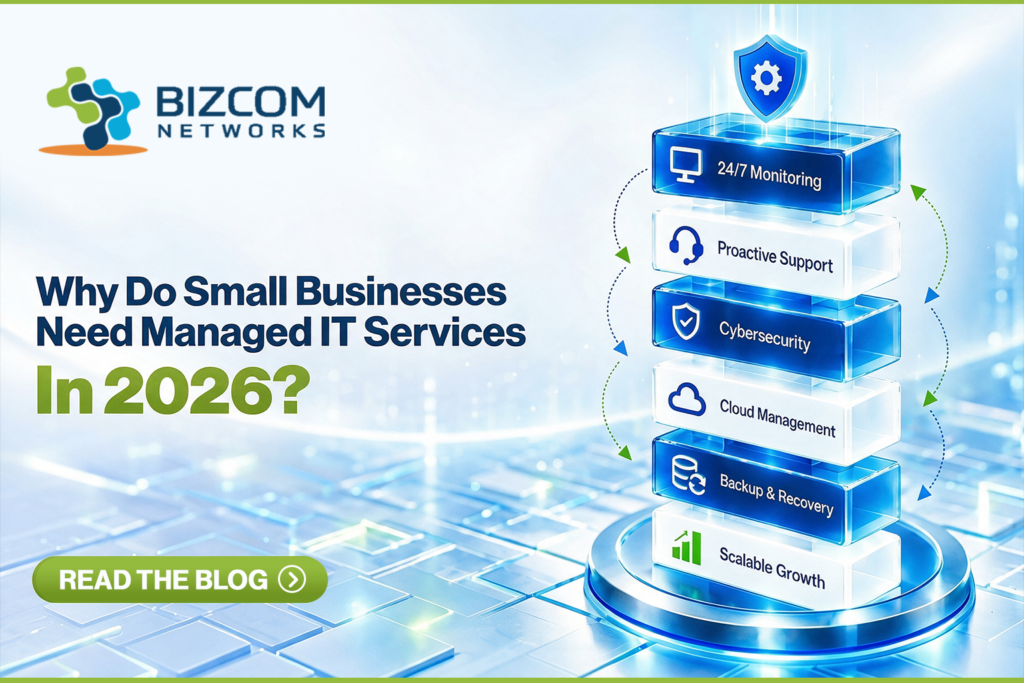
A managed IT services small business model shifts your technology from a cost center you deal with when things go wrong to a strategic function that’s actively monitored, maintained, and improved. Instead of hiring an internal team, a business partners with an MSP that provides:
- 24/7 network monitoring and helpdesk support
- Proactive patching, updates, and system maintenance
- Cybersecurity protections, including endpoint detection, firewalls, and employee training
- Cloud management for platforms like Microsoft 365, AWS, and Google Workspace
- Data backup and disaster recovery planning
- Strategic IT planning and budgeting support
Example: A 25-person accounting firm handling sensitive client financial data can’t afford unplanned downtime during tax season. By moving to outsourced IT services, the firm gets around-the-clock monitoring, automated backups, and a security stack built for compliance – without hiring a full internal IT department. A regional healthcare clinic facing HIPAA requirements might use an MSP specifically for compliance monitoring, encrypted backups, and access controls, since a single violation can trigger fines that far exceed a year of managed services fees.
Benefits for Businesses
- ROI: Predictable flat-rate pricing replaces unpredictable break-fix bills and emergency repair costs.
- Productivity: Fewer outages and faster issue resolution mean employees spend more time working and less time waiting on IT.
- Cost savings: Organizations that use MSPs report reducing overall IT costs by 20% to 30% compared to maintaining an internal team.
- Security: Continuous monitoring and layered defenses dramatically reduce exposure to ransomware, phishing, and data breaches.
- Scalability: IT infrastructure can expand or contract with your business without the lag time of hiring or retraining staff.
Industry Trends Shaping Managed IT in 2026
Several shifts are changing what small businesses should expect from an IT partner in 2026:
- AI-driven support: AI-powered ticketing and monitoring tools are cutting resolution times significantly, letting MSPs catch and fix problems before employees even notice them.
- Automation: Routine maintenance, patching, and reporting are increasingly automated, reducing human error and freeing up technicians for higher-value work.
- Cloud-first operations: Most SMBs now treat cloud infrastructure as central to daily operations rather than an optional upgrade.
- Compliance pressure: A majority of small and midsize businesses report needing outside help to keep pace with data privacy and industry-specific regulations.
- Cybersecurity as a core offering: Managed security is now the fastest-growing segment of IT outsourcing, reflecting how central protection has become to any IT strategy.
Managed IT vs. Traditional IT: A Side-by-Side Comparison
| Traditional IT | Managed IT |
| Reactive – fixes issues after they occur | Proactive – monitors and prevents issues 24/7 |
| Unpredictable, hourly break-fix billing | Flat-rate, predictable monthly pricing |
| Limited in-house expertise | Access to a full team of specialized experts |
| Security added as an afterthought | Security built into every layer of service |
| Scaling requires new hires | Scales instantly with business growth |
Best Practices and Expert Tips
- Ask any prospective MSP for their average response time and uptime guarantee in writing, not just verbally.
- Prioritize providers who include cybersecurity and compliance support as a standard part of their package, not an upsell.
- Choose a partner who provides a dedicated account manager rather than a rotating support queue.
- Confirm how backups and disaster recovery are tested, not just how they’re configured.
- Review contracts for flexibility – your IT needs will change as your business grows.
Frequently Asked Questions
What is included in managed IT services for small business?
Most packages include network monitoring, helpdesk support, cybersecurity protections, cloud management, and data backup, bundled into one predictable monthly fee.
How much do managed IT services cost for a small business?
Pricing typically runs on a per-user or per-device basis, with costs varying based on the scope of services and the complexity of your environment.
Is outsourced IT support secure?
Yes – reputable providers build security into every layer of service, often exceeding what a small internal team could maintain on its own.
Can managed IT services replace my internal IT staff?
They can fully replace an internal team or work alongside existing staff in a co-managed model, depending on your business needs.
How do I switch from my current IT provider to a new MSP?
A qualified MSP will handle onboarding and data migration with minimal disruption, typically completing the transition within a few weeks.
What size business benefits most from managed IT services?
Businesses of nearly any size benefit, but companies with 10 to 250 employees see some of the strongest returns, since they need enterprise-grade support without the cost of a full internal department.
Conclusion
The technology gap between small businesses and their larger competitors is closing fast – but only for companies willing to invest in the right IT foundation. Managed IT services small business solutions deliver the security, reliability, and scalability that used to be reserved for enterprise budgets, at a cost structure built for growing companies.
Bizcom Network has spent years helping small and midsize businesses move from reactive IT headaches to proactive, secure, and scalable technology environments. If your business is ready to stop firefighting and start planning ahead, our team can help you build an IT strategy that fits your goals.