
Technology does not fail on a schedule. A server crashes on your busiest sales day. A phishing email lands in the one inbox with access to payroll. A software update breaks the tool your team depends on to invoice clients. None of it waits for a convenient moment, and none of it gets handled by hoping it will not happen.
That is the case for IT support services: not a line item you tolerate, but the infrastructure that keeps everything else running. Every business, regardless of size, now depends on systems it does not fully control internally, cloud platforms, email, payment processing, remote access. When those systems go quiet, the business goes quiet with them.
This article covers what business IT support actually includes, why doing without it is riskier than most owners realize, and how to evaluate whether outsourced tech support services make sense for where your company is today.
The Current Business Challenge
Most companies operate somewhere between having no IT strategy and relying on one overworked person to handle everything. Neither position holds up under real pressure. Technology has become the operational backbone of almost every function, sales, finance, HR, customer service, yet the people running the business are rarely equipped to secure or maintain it.
The result is a pattern that repeats across small and mid-sized companies: problems get fixed only after they have already interrupted work. Security updates get delayed because nobody owns the task. Backups exist but have never actually been tested. A key employee leaves, and the passwords and system knowledge leave with them. None of this looks like a crisis until the day it becomes one.
Meanwhile, the systems businesses rely on have gotten more complex, not less. Cloud applications, remote work, and interconnected software mean a single weak point can now affect the entire operation rather than one department.
What You Need to Know
At its core, IT support is the ongoing management, maintenance, and troubleshooting of the technology a business runs on, networks, devices, software, security, and data. It ranges from help desk requests, like a sync issue in email, to infrastructure-level work like patch management, backup verification, and cybersecurity monitoring.
Businesses generally get this in one of three ways: an internal IT hire, a break-fix contractor called only when something breaks, or an outsourced provider delivering ongoing business IT support under a structured agreement. The first is expensive and hard to scale. The second is reactive by design. The third, a managed model, is built around prevention, monitoring systems continuously so problems get caught before they interrupt anyone’s day.
Example: A 30-person marketing agency without dedicated support might lose half a day every few weeks to slow computers, expired licenses, or account lockouts, small issues that add up to real productivity loss. A structured tech support services agreement resolves most of that before employees even notice it was a problem.
Benefits for Businesses
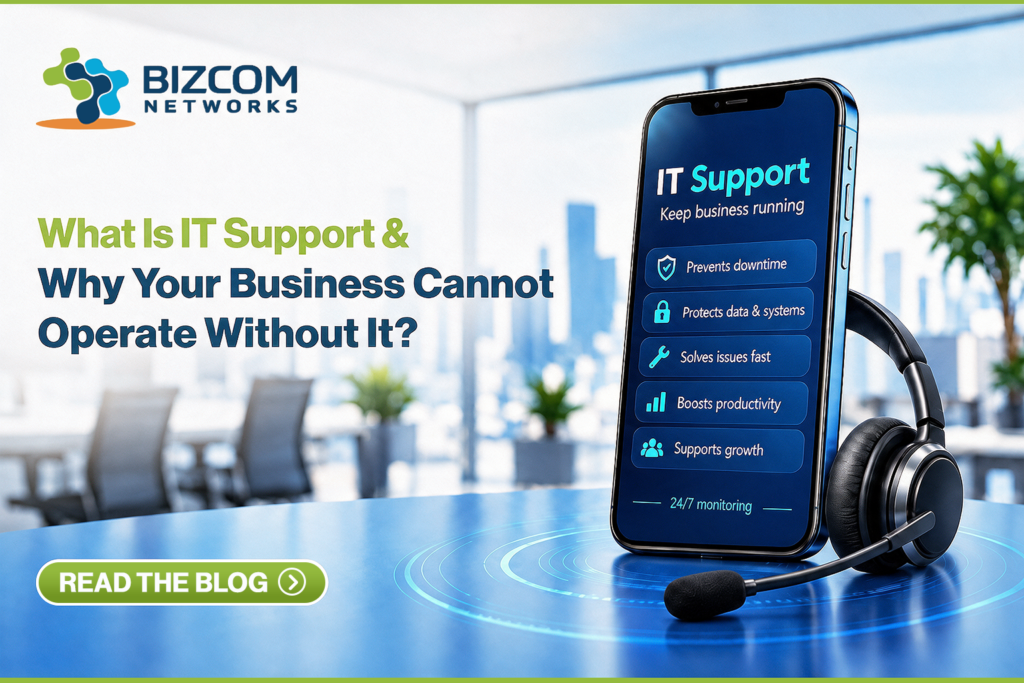
Reliable IT support services pay for themselves in ways that show up directly on the balance sheet:
- ROI: Preventing an outage costs far less than recovering from one, most IT budgets are cheaper than a single day of lost operations.
- Productivity: Employees stop losing hours to slow systems, login issues, and outdated software.
- Cost savings: Predictable monthly support replaces unpredictable emergency repair bills.
- Security: Continuous monitoring and patching close the vulnerabilities most breaches exploit.
- Scalability: Support expands as headcount and technology needs grow, without a hiring cycle.
Industry Trends
A few shifts are reshaping what businesses should expect from IT support in 2026:
- AI-assisted monitoring: Predictive alerts now catch failing hardware and performance issues before they cause downtime.
- Automation: Patching, ticketing, and reporting are increasingly automated, cutting resolution times.
- Cloud dependency: With operations running through cloud platforms, an outage outside your building can still stop your business.
- Compliance pressure: Data privacy and industry-specific regulations are reaching further into small and mid-sized companies.
- Cybersecurity as standard: Security monitoring is now treated as a baseline service, not an optional add-on.
No IT Support vs. Dedicated IT Support Services
| No IT Support | Dedicated IT Support Services |
| Issues surface only after they have already caused damage | Issues are monitored and caught before they escalate |
| Staff lose hours troubleshooting instead of working | A help desk resolves issues in minutes |
| Security gaps go unnoticed until a breach happens | Continuous protection closes gaps before attackers find them |
| No documented recovery plan if systems fail | Tested backup and disaster recovery built in |
| Technology decisions made reactively, under pressure | A strategic partner plans infrastructure ahead of growth |
Best Practices / Expert Tips
- Get response-time and uptime commitments in writing, not just verbal assurances.
- Ask exactly what is included in a support agreement, cybersecurity and compliance should not be an upsell.
- Confirm backups are tested regularly, not just scheduled.
- Choose a provider offering 24/7 monitoring, since most serious issues do not happen during business hours.
- Revisit your IT agreement annually, the right level of support changes as the business grows.
Frequently Asked Questions
- What are IT support services?
They cover the ongoing management, monitoring, and troubleshooting of a business’s technology, including networks, devices, software, and security, so systems stay reliable and secure.
- Why does my business need dedicated IT support?
Without it, small technology issues often go unnoticed until they cause downtime, data loss, or a security breach that costs far more to fix than ongoing support would.
- What is the difference between business IT support and a break-fix contractor?
A break-fix contractor is paid to fix problems after they happen. Dedicated IT support monitors systems continuously to prevent those problems in the first place.
- Are tech support services worth it for a small business?
Yes, the cost of ongoing support is typically far lower than the cost of a single major outage, data breach, or emergency repair.
- Can IT support services help with compliance?
Experienced providers build compliance documentation and security controls into their service, which most small businesses cannot maintain with internal staff alone.
- How quickly can a business start with outsourced IT support?
Most providers can begin with an infrastructure audit within days and complete onboarding within a few weeks, with minimal disruption to daily operations.
Conclusion
Technology does not run itself, and waiting for something to break before addressing it is no longer a viable strategy for any business that depends on its systems to operate. Reliable IT support services turn technology from a source of risk into a foundation the business can actually rely on.
Bizcom Network helps businesses build that foundation, proactive support, security, and infrastructure planning designed to keep operations running, not just react when they stop.
Ready to see where your IT setup stands? Learn More about Bizcom Network’s IT Support Services.